

The training titled “Local Cooperation and Responsible Mining” was successfully held in Ulaanbaatar on October 6, 2025.
The event was organized by the Mongolian Council for Sustainable Development and Social Responsibility (CSS Mongolia) at the initiative and request of the Governor’s Office of Umnugobi Province. The training aimed to strengthen relations between the mining sector and local communities and to enhance the effectiveness of cooperation agreement implementation.
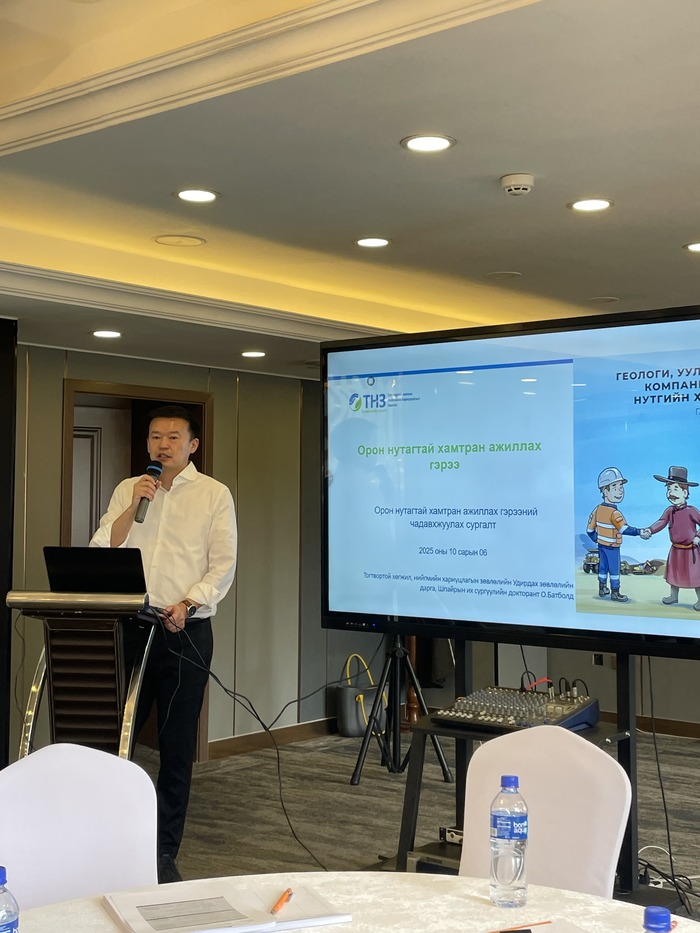 Representatives from 15 mining companies operating in Umnugobi province, along with local governors and members of cooperation committees from Tsogttsetsii, Bayan-Ovoo, Bayandalai, Khanbogd, Mandal-Ovoo, Noyon, and Gurvantes soums participated.
The training was opened by J. Zanabazar, Deputy Governor of Umnugobi Province, who highlighted the importance of collaboration between local administrations and mining companies and expressed confidence that the training would make a valuable contribution to this effort.
J. Sunjidmaa, Board Member of CSS Mongolia, gave a presentation on “Mining and Local Relations”;
Lawyer and Attorney Ts. Tsetsenbaatar discussed the legal framework and structure of the model cooperation agreement; and O. Batbold, Chair of CSS Mongolia, spoke about agreement implementation, accountability mechanisms, and transparency, leading an open discussion.
In the afternoon session, more representatives from mining companies joined. G. Erdenetuya, Executive Director of the Mongolian National Mining Association, delivered a presentation on “Responsible Mining”.
Dr. D. Byambajav, a researcher at the University of Queensland, joined online to discuss the importance of social license and trust.
Other speakers included D. Erdenechimeg, Governance Program Manager of Open Society Forum, G. Sugar, General Manager for Communities at Oyu Tolgoi LLC, and O. Batbold, Chair of CSS Mongolia, who presented on experience, risks, opportunities, partnership principles, challenges, and solutions related to cooperation agreements.
At the end of the training, participants held a discussion and identified trust, transparency, mutual respect, and community participation as the key factors for successful implementation of cooperation agreements.